


Previously Funded Research
AONL Foundation Research Grant Program Impact Report
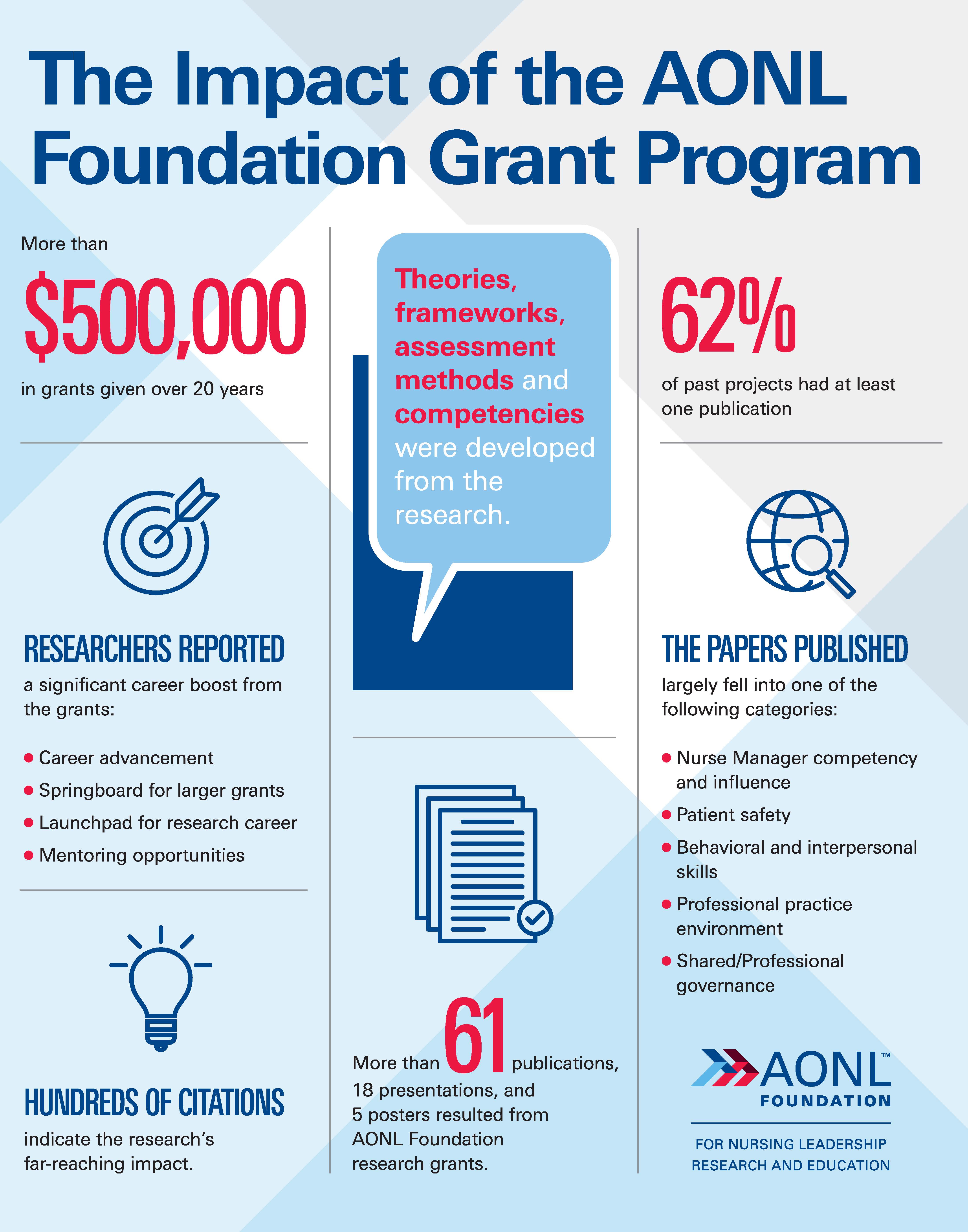
The AONL Foundation Research Program has granted more than $500,000 to influence new knowledge through nursing leadership research, ultimately benefiting all healthcare constituents – from patients and families to communities to nursing leadership and healthcare teams.
The Research Impact Subcommittee interviewed 61% of past grant recipients to answer, “How have AONL Foundation research grants impacted leadership practice, careers, patient care, and leadership and system science”? The research team consisted of 8 individuals. Frequencies and thematic analysis were used to answer the question. Overall, responses demonstrated that the AONL Foundation has impacted careers, enhanced academic practice, developed innovations, and has wide dissemination and adoption. Below are the results using frequencies, themes, and sub-themes.
John Whitcomb, PhD and Lori Stanley, DNP, RN, NEA-BC, CENP
Clemson School of Nursing
$6,508 Sustainable Nursing Workforce Development Grant made possible by a generous gift from the Versant Center for the Advancement of Nursing®.
Innovative Teaching and Learning: Key Metrics of an Undergraduate Nursing Academic and Clinical Learning Environment
Purpose: A newly established education and practice collaborative doubled the numbers of baccalaureate registered nursing students admitted to the nursing education program. The purpose of this study is to investigate key metrics during the first two crucial launch years: (a) the perceptions of the learning environment – using the Quality Clinical Placement Evaluation (QCPE) ; (b) the percentage of student clinical placements at partnership clinical sites in relation to requested clinical placements; (c) the concurrent completion of the healthcare service’s new hire residency skills checklists as part of the nursing program of study (d) the change in the students’ critical thinking scores-- the ETS proficiency profile (5) the financial expenditures for travel nurses, RN overtime, and RN orientation.
Background and Significance: The “Future of Nursing” and the “Manatt” reports identified the benefits of innovative academic and clinical learning partnerships to build a pipeline of bedside nurses. South Carolina is 44th worst state in health rankings and predicted to have the 4th highest nursing shortage by 2030.
Methods: Using a prospective, descriptive, correlational research design surveys of perceptions of clinical environments and critical thinking and other key data will be analyzed at three intervals during the students’ final semesters.
Implications: Analysis of key metrics support the nursing leaders in health care systems and in academia to capture the effects of clinical placements, make comparisons over time, and underscores the importance of the quality clinical experience during undergraduate nursing degrees, so important to the development of students as beginning health professionals.
Sandy Galura, PhD, RN (Principal Investigator)
University of Central Florida College of Nursing
$14,985 Leadership Equity / Equitable Health Care Research Grant made possible by a generous gift from AMN Healthcare.
An Examination of Workload, Responsibilities, and Barriers to Equitable Access to Leadership Roles Peri Pandemic: A National Study of Nurse Managers
Nurse managers (NMs) are pivotal to quality outcomes. Overwhelming workload is a critical contributing factor to NM stress, job satisfaction, and intent to leave. During the COVID-19 pandemic, already stretched NMs were further tasked to operate in disrupted work environments adopting innovative practices that many organizations are now choosing to continue. These ‘moving targets’ of responsibilities and accountabilities overwhelm NMs and must be addressed. Further, as the workload of NMs is evaluated with an eye toward recruitment and retention of a leadership workforce that represents the cultural diversity of patient populations, consideration must be given to understanding demographic barriers that may limit interest in this pivotal role. The purpose of this study is to examine and compare the work and practice environment of a diverse sample of NMs before the COVID-19 pandemic and during this peri-pandemic period to understand their evolving role responsibilities, including barriers encountered while in their leadership role and when seeking leadership roles. Using a mixed methods design, we will conduct a three-phase study. In phase 1, quantitative survey data will be examined to validate a newly created Nurse Manager Responsibilities (NMR) tool. In phase 2, we will quantify NM workload using the NMR tool and explore the relationships among aspects of the job, personal characteristics, and the NM practice environment using the Nurse Manager Practice Environment Scale (NMPES). During phase 3, we will conduct semi-structured interviews, and examine these same concepts to provide deeper insights into NM workload and responsibilities, including barriers associated with equitable access to NM roles. Findings may provide insight for future research to 1) further develop a nurse manager workload tool, 2) develop an algorithm or metrics for analyzing and comparing NM workload, 3) understand the relationship between job satisfaction, workload, and NM’s race and ethnicity, 4) develop strategies to guide NM resource allocation and innovative role support, 5) create new models for the NM work, and 6) develop potential recruitment strategies for increasing diversity among NM.
Association of Leadership Science in Nursing and AONL Foundation
Esther Chipps, PhD, RN, NEA-BC (Principal Investigator), The Ohio State University Wexner Medical Center, The Ohio State University College of Nursing, Board Member, ALSN
M. Lindell Joseph, PhD, RN, FAAN (Co-Principal Investigator), University of Iowa, College of Nursing, Board Member, AONL Foundation
Setting the Research Agenda for Nursing Administration and Leadership Science: A Delphi Study
A priority for ALSN is to advance research in nursing administration and leadership. Nearly five years ago, the ALSN identified nursing administration research priority categories and significant research emerged in those eight categories: economic value of nursing, design of future nursing practice and care delivery systems, healthy practice environments patient safety and outcomes research, leadership education, effective leadership using information technology to transform care, and innovative research design and frameworks. In assessing the progress since the publication of the Future of Nursing report, the National Academy of Medicine recognized the continued need to develop nurse leaders and collect workforce data to support research on new models of health care delivery that improve patient outcomes. To advance research in nursing leadership and administration, it is time to review and identify new nursing leadership/administration research priorities in order to establish the research agenda for 2020 and beyond. We propose that this research agenda will service to identify current gaps in our knowledge and provide a research trajectory for the next 5 years.
The aims of the study are:
To identify nursing leadership and administration research topics of importance in the USA and Canada. To prioritize and reach consensus on the identified research priorities; and To develop a nursing administration research agenda for 2020-2025.
Nora Warshawsky, PhD, RN, FAAN
University of Central Florida
$50,000 grant in honor of AONL’s 50th Anniversary (2017)
Evaluating the Impact of Nurse Manager Job Design and Practice Environment on Achieving the Quadruple Aim
Presented at the AONL 2021 Virtual Conference.
Healthcare leaders are responsible for setting the strategic direction of healthcare organizations; therefore, responsible for enacting the Institute of Healthcare Improvement’s (IHI) Quadruple Aim. Nurse managers create the environments necessary to achieve quality patient experiences and outcomes, reducing costs of care, and creating high performance teams at the point of care. Thus, leveraging nurse managers to advance the Quadruple Aim is critical to organizational success. Given the wide variation in job design and the dearth of evidence on effective job design and practice environments needed to maximize nurse managers’ job performance, we propose to determine which aspects of job design and practice environments assist nurse managers in achieving the Quadruple Aim. This study aligns with AONE’s priority to understand the impact of nursing leadership on achieving the IHI Quadruple Aim by determining effective job design of the nurse manager role.
The cross-sectional study design will use an electronical survey of nurse managers to assess their role preparation, self-assessed competence, job design, practice environment (using the Nurse Manager Practice Environment Scale), and nurse manager demographics. Press Ganey is administering the survey in 70 hospitals to nurse managers responsible for units that provide patient care and participated in the nurse survey in the past two years. The Nurse Manager survey data will be linked to unit-level RN survey data including the following measures: the Practice Environment Scale of the Nursing Work Index (PES-NWI), intent to stay in their position, job enjoyment, RN reported quality of care, and missed nursing care. Descriptive statistics will be used to examine and describe nurse manager practice environment, span of control, and position support. Multilevel mediation modelling will be used to test our hypotheses. Recommendations for improving job design and practice environments to support effective nurse managers will be made based on our findings.
Jennifer Rainer, RN, PhD candidate
Saint Louis University
$12,475 small grant made possible by a generous gift from Atrium Health in honor of CHS Nurses.
Speaking up or Remaining Silent: Understanding the Influences on Nurses When Patients are at Risk
RNs leave the profession prematurely because of high physical demands and burnout. One cause of burnout is moral distress resulting from situations where RNs know the right thing to do, but organizational constraints (e.g., lack of managerial support to challenge physicians’ end-of-life decisions) create barriers to speaking up. Failure to speak up (i.e., using one’s voice to share information or alert those in authority) contributes to patient harm. Conversely, when RNs speak up, they are demonstrating moral courage, which strengthens organizational culture and enhances patient safety. While moral courage encompasses many behaviors and situations, speaking up is specific to verbal advocacy at a critical time. The principal investigator (PI) previously published a theory synthesis which resulted in a speaking up model. She found that speaking up is primarily influenced by organizational culture, personal culture, and workforce generation. Further, speaking up can lead to moral courage; failure to speak up can lead to moral distress. Moral courage and distress have been well explored in the literature, however, there is little evidence regarding what influences RNs to speak-up or remain silent. To address this gap, the purpose of this study is to understand the relationships among factors that influence RNs speaking up and how speaking up is related to moral courage and distress. The aims are to (1) explore the factors that influence RNs speaking up and (2) test the model that workforce generation, personal culture, and organizational culture influence speaking-up behavior and moral courage and distress. These aims will be accomplished through an on-line quantitative survey for bedside nurses, consisting of the Safety Attitudes Questionnaire, Moral Distress Scale Revised, and Moral Courage Scale, reflecting the constructs of the PI’s model. RNs will be recruited through state and national nursing associations to ensure diversity in personal culture, organizational culture, and workforce generation. Data analysis will include descriptive statistics (to identify violations of assumptions), Pearson correlations (to address aim 1), and structural equation modeling (to address aim 2). Limitations include self-reporting inflation (which will be mitigated with anonymity), recall error (mitigated by excluding RNs without current bedside experience), and cross-sectional ambiguity regarding temporal precedence. This design is an important first step in understanding the factors that contribute to speaking up or remaining silent. The findings, aligned with AONE strategic priority #3, will help RNs to better provide safe, quality care through delivery systems grounded in healthy practice environments.
Diana Meyer, DNP, RN, NEA-BC, FAEN, and Research Team
In memory of Susan Cline, DNP, RN, NEA-BC
St. Luke’s Health System
$50,000 Sustainable Nursing Workforce Development Grant made possible by a generous gift from the Versant Center for the Advancement of Nursing®.
Cultivating Joy and Resilience in Nursing Through a Practice Playbook.
Publication:
Koprowski, Kristen; Meyer, Diana; Stanfill, Teresa; Tivis, Laura J. Cultivating joy: Improving nurse resilience through use of a practice playbook. Applied Nursing Research. 2021;62.
Resilience is defined as an individual's or organization's ability to respond and recover in adversity. Transformational nurse leaders must demonstrate, develop, and implement resilience strategies in the teams that they lead. The evidence suggests that strengthening resiliency will improve nurse engagement and well-being, care quality, and patient safety. The purpose of this study is to assess whether nurse leaders' implementation of a practice playbook improves resilience in direct care nurses in a health system that includes nine hospitals and 280 ambulatory clinics. The study investigators will develop and implement a Resilience Playbook. The Playbook will include a menu of strategies for leaders and staff to choose from, including structured stress-reduction programs, writing, yoga, salons and daily gratitude practices. The Resilience Playbooks will be implemented with nurses at all levels of the organization, new graduate registered nurses, and BSN students during their leadership course. The impact will be measured by the Conor-Davidson Resilience Scale (CD-RISC). Following IRB approval, pre and post-implementation surveys will be distributed to registered nurses providing direct patient care over fifty percent of their work time. Data will be analyzed using independent t testing.
Yolanda Keys, DHA, RN, NEA-BC, EDAC
Texas A&M University
$7,310 Sustainable Nursing Workforce Development Grant made possible by a generous gift from the Versant Center for the Advancement of Nursing®.
Mitigating the Adverse Effects of 12-hour Shifts: Nurse Leaders’ Perspectives
Presented at the 2020 AONL Virtual Conference.
Publication:
In spite of evidence that long shifts are problematic, the use of 12-hour shifts in acute care nursing has become the norm. Although the scheduling convenience of 12-hour shifts may be perceived as a benefit for both nurses and nurse leaders, the strain of long shifts can lead to adverse outcomes for nurses, organizations and patients. Nurses who work shifts greater than or equal to 12-hours are at increased risk for injury, fatigue, and job stress, which predisposes them to burnout and a desire to leave their position or the profession. Organizations pay the price for burnout related turnover in the form of replacement costs upwards of $25,000 per nurse. Patients who are cared for by nurses working long shifts have higher levels of dissatisfaction and may experience missed care interventions, sub-optimal outcomes, and greater than expected risk of mortality.
The Job Demands-Resources model is used to frame the 12-hour shift as an acute care nursing job demand and as such, supports the identification of job resources to help alleviate stressors related to demands. The purpose of this study is to investigate approaches of support targeted to mitigate the adverse effects of working 12-hour shifts for nurses in acute care settings.
A modified, e-Delphi format was selected to engage a range of expert opinions. Three rounds of surveys will be administered to expert nurse leader participants who respond to AONL e-newsletter announcements. The first round will gather qualitative information about support and resources to mitigate the adverse effects of the 12-hour shifts, and the two subsequent rounds will synthesize round one data with a consensus identification and priority ranking of resources and recommendations for implementation of these approaches.
This initiative aligns with two of AONL’s Strategic Priorities. First, it focuses on supporting the Institute for Healthcare Improvement’s Quadruple Aim to improve the experience of the caregiver and improve patient safety. Second, it supports the development of evidence to help nurse leaders build and sustain a resilient workforce.